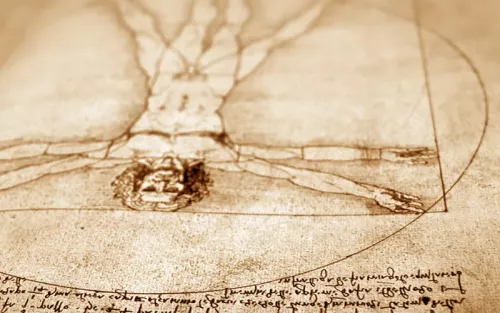
We've all seen Leonardo da Vinci's sketch of the Vitruvian Man, his arms and legs spread apart, the entire figure contained within a circle and a square. Leonardo believed that this image depicted the ideal human proportions. Of course, no one's physical measurements meet these benchmarks. And if a client is coming to you for healing, their physical health doesn't meet optimum standards either. However, no matter what hardships a client is experiencing, through an energetic point of view, the body perfectly explains what is wrong and what is required.
iStock.
The body is a mechanical system, but it also reflects a person's essential self, or spirit. Because of this, the body can be considered a metaphor, mirroring exactly what is occurring within a person's deeper self. In fact, every bodily area relates to a specific life concern and conveys a spiritual idea. By understanding the meaning of various body parts, you can better illuminate the nature of the illness, pain, or struggle reflected in a bodily challenge. After bringing that part of the body back "online," you can take another leap forward. You can activate the spiritual quality innate to that body part. The body is supported in healing. In the end, it might not exactly resemble Leonardo's sketch, but it can serve as the expression of the divine that it is.
In this article, I'll bring this rather philosophical idea down to earth and straight into your practice. Applying the theory that the body is a metaphor can be as easy as employing the listings at the end of this article. In order to best understand what a client's bodily challenges are revealing, however, it's helpful to first understand the basic idea behind my concept. The simple answer to the question, "How can the body be a metaphor?" lies in a one-word response: "energy."
Energetics of the Body
While a bodyworker must understand the complexities of the mechanical body—such as the locations of various muscles, organs, and other tissues—it's equally vital to comprehend the function of subtle energies. Physical reality is based on subtle energies, which serve as a sort of lattice on which physical energies climb and organize. A disease appears in the body when subtle energies are imbalanced. The illness can disappear when the subtle energies are brought into balance.
To understand the specificity of each body part, it's important to know that each part of the body functions on a different band of physical and subtle frequencies. Picture a vertical spectrum of electromagnetic energy or light superimposed over a human body. The top of the body vibrates with higher frequencies and faster wavelengths than does the lower part of the body. From a horizontal perspective, the light moving out from the body's core shifts from lower to higher vibrational rates. The sonic waves of the body work the same way. On the top of the body are higher-pitched sounds; on the lower part of the body are lower-pitched sounds. And the sound vibrations shift from lower to higher from the center outward.
This basic understanding of the body's energetics means that every single part of the body functions on a unique set of frequencies. The nose is slightly higher in the body than the neck, and so, compared to the neck, it operates on relatively higher sound and light waves. This means that the nose and neck will resonate with, and respond to, different energies, or vibrating pieces of information.
The physical energy corresponding to each body part is relatively easy to determine. You can actually see, touch, hear, feel, and even smell the differences between bodily areas. However, the information in—and vibration of—subtle energies is quite complex. Subtle energies are actually composed of codes made of physically oriented data but also psychological and spiritual ideas, across-time memories and projections, and various sound and light vibrations. Still, if you crack the code of the subtle energies, you can fix the bad data and activate healthy data, thus returning that body area to full function. In short, by treating the body as a metaphor, you can alleviate very real conditions.
The more often you perceive the body as metaphor, the closer you'll get to an understanding of the true spiritual nature of reality.
Metaphors of the Body
The idea of body as metaphor isn't a new one. Wisdom keepers, shamans, and healers across time and cultures have assumed the truth of this idea and conducted healing based on it. In ancient Greece, the human body was essentially viewed as holding the key to realizing spiritual advancement. It was thought that physical organs veiled spiritual centers and could therefore be transformed upon embodying specific spiritual qualities.1
Most ancient Asian medical systems, including traditional Chinese medicine, have consistently postulated that an organ is part of an organ system, and that each system governs specific ideas, attributes, emotions, and types of energy. In particular, liver problems occur when we're too stressed, the heart reflects contentment, and stomach problems happen when we worry too much.2
Paracelsus, an alchemist who lived from 1493-1541, was one of many scientific philosophers who asserted that the human body was a holographic image of the greater universe, and its health relied on harmonizing with nature. Thus, the body, and various parts of it, reflect aspects of the natural order. Paracelsus thought every organ not only epitomized a specific meaning, but was also associated with a planet, element, property, and set of qualities.3
Even the Bible proposes that the body reflects God's will and a person's soul, every part an expression of a spiritual dynamic.4 For instance, the nose lends the ability to snort and get angry, the ears relate to hearing and higher understanding, the arms represent life, and the hands serve as instruments of creation.5
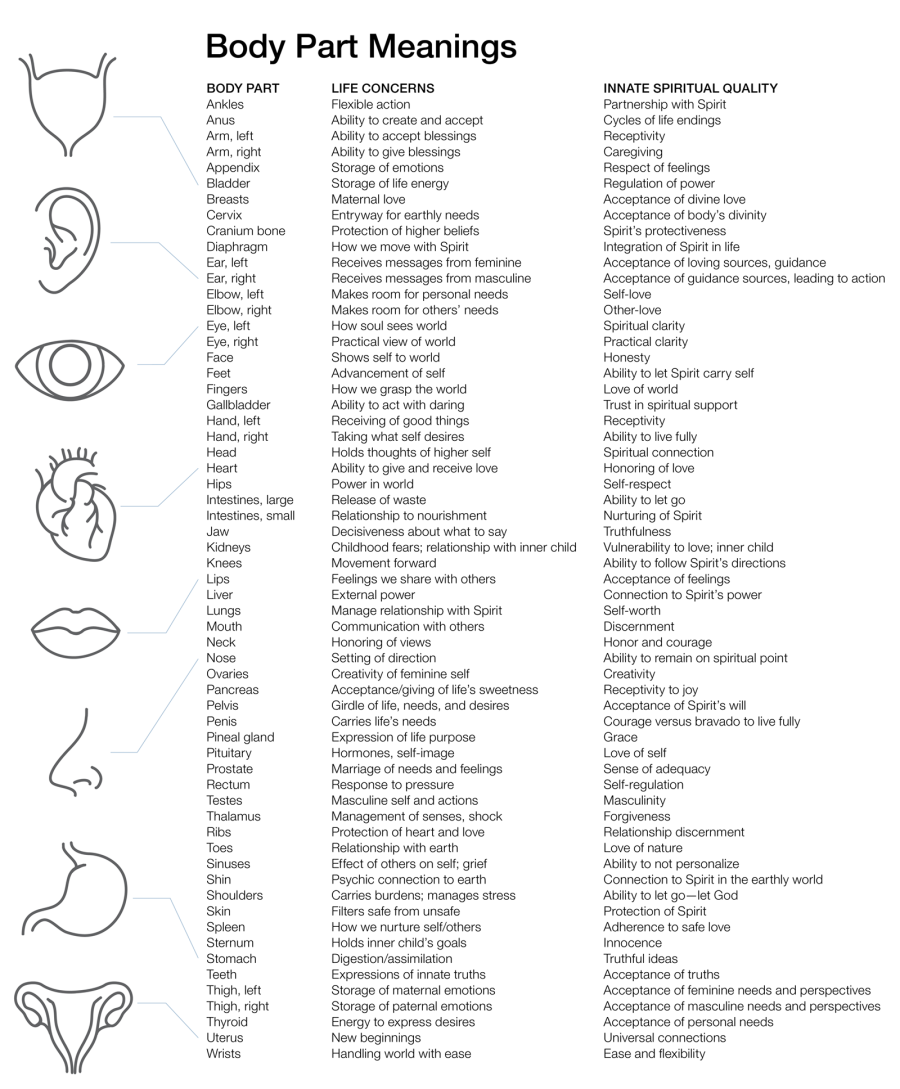
How can you best support a client with applying the body's metaphorical meanings? Simplistically, you can use the list provided on page 100 of this article. Basically, look up the body part or system causing a client's challenge. Also consider the location of the difficulty, as the sides of the body each represent different concerns.
Sides of the Body
Left Side of the Body. Relates to feminine concerns, such as receptivity, intuition, creativity, and emotions.
Right Side of the Body. Consider masculine issues, such as activity, drive, achievements, and thoughts.
Front Side of the Body. Refers to the conscious and everyday issues facing a client.
Back Side of the Body. Relates to unconscious and spiritual ideas and experiences of the soul.
In general, you'll first help the client select the most challenged body part and then look up the related issue on the list at left. Also consider the right/left/front/back location. For instance, if a client is experiencing right hip pain, you'll surmise that they're examining how to achieve worldly power. With that in mind, the client will take the second step, which involves figuring out how to embrace or better express the spiritual quality related to the body part. In this case, the attribute involves respecting themselves.
What if you don't believe your client will want to take these steps? Maybe it's not appropriate to discuss these issues aloud with them. You can rely on the power of intention. Conduct the steps yourself and ask that the client's higher self enable a clearing of the bodily issue and an introduction of the needed spiritual quality. On the subtle level, anything is possible.
Body Systems
Circulatory. Flow of love and cycles of life.
Digestive. Ideas, ideals, and ability to choose between what is and isn't suitable.
Excretory. Release, waste management, and ability to let go.
Nervous. Communication, flow of vital energy, and movement of light and sound.
Muscular. Willpower for setting and achieving goals. Soft tissues are related to connectivity to others, the self, and the world.
Reproductive. Feminine power, fertility, and creativity.
Respiratory. Expression of personal spirit and one's relationship with Spirit.
Skeletal. Foundation, the framework of self in the world.
The more often you perceive the body as metaphor, the closer you'll get to an understanding of the true spiritual nature of reality. As shared by Ludwig Wittgenstein, "The human body is the best picture of the human soul." You could say the body is a gateway of heaven on earth.
To understand tissue-tension barriers, MTs must be constantly present and mindful. Too light and we will not become efficient at creating the healing change that is needed.