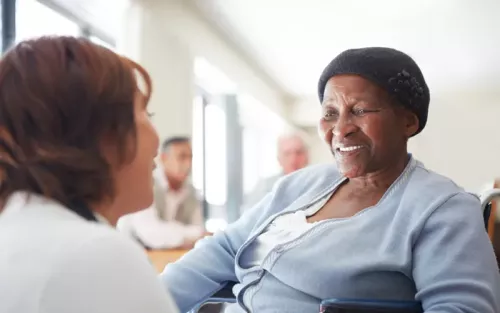
I take "Martha" in her wheelchair to her room. She has just finished eating lunch. Her fingers are covered with sticky chocolate that I wipe with a warm, wet cloth; I smile and banter in play with her. Her sentences and words are scrambled. Martha is living with Alzheimer's.
But something stunning happens when I massage her—she closes her eyes, becomes silent, and says, "that feels good" and "oh, so nice." I massage her scalp, neck, shoulders, and upper back, as well as her arms, hands, legs, and feet. She purrs like a kitten. When I am finished, she opens her eyes; they sparkle with renewed life. Martha smiles brightly and says, "You are a sweetheart. I was feeling so bad today, but you made me feel so good. I feel like a new woman. What a gift you have given me. Thank you." Her words are clear and coherent. Her sentences are complete. She is present and looks at me for a moment as if she is breathing me into her skin.
The words come from the same person who most of the time speaks in jumbled and nonsensical words and phrases. And the bright eyes belong to someone who normally wears a dazed, confused expression. This is a rare moment in her day—and a gem of a moment for me.
iStock.
Frail Elders Have a Need for Massage
Required by law to not overmedicate their patients, more and more skilled nursing facilities are seeking alternative therapies for their residents to help lessen the use of pain medication. There is a great need in these facilities for a caring, healing touch.
Frail elders who may be bed-bound or wheelchair-bound are often touch-deprived. Can you imagine what it would be like to not be able to leave your bed? A caring massage by a therapist who loves working with frail elders can be the highlight in someone's day or week, and something they look forward to on a regular basis.
Where Language Fails
When working with frail, older adults, touch can sometimes be more effective than words, especially when working with Alzheimer's clients. Touch communicates in a way that language may fail. Massage can bring joy to someone who is sad, a sense of connection to someone who feels isolated or lonely, and peace to those who are agitated or restless. It can revitalize and renew, bring comfort, soothe, and console.
The Benefits of Massage for Frail Elders
For this population of clients, some of the benefits of massage are especially relevant. Massage has the potential to:
Lessen the use of certain medications
Ease the discomfort of bedsores caused by sitting or lying in one position for an extended time
Ease pain and anxiety
Encourage overall well-being
Help with stiff, sore muscles
Improve flexibility
Relieve constipation
Help alleviate symptoms of depression
Stocksy.
Lifted Up by Massage
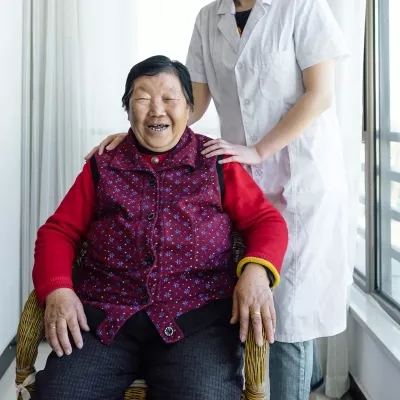
Massage is not only salve for the body, it's salve for the soul. I've been seeing 90-year-old "Leah" for the last four years. She is frail, uses a wheelchair, has Parkinson's, and has dealt with depression and anxiety her whole life. She can be gruff, irritable, and hard to please. At the suggestion of her psychotherapist, Leah had her first massage at 86. Her daughter, the primary caregiver, was extremely doubtful. She was frustrated and had given up on trying anything new, because nothing seemed to work. But Leah's psychotherapist had an intuitive hunch that massage might work. And it did. It was life-changing.
Leah suddenly began smiling, her face softened, her anxiety was eased. Though her depression has never gone away entirely, massage helped lift it. A little window of joy and light suddenly opened and passed through her during and shortly after the massage sessions. She even began greeting her neighbors, something she had not done before. I love to see her smile and hear her tell me how much more at peace she feels, and how the massage seems to be the only thing to really help her with her anxiety. Though the change is not permanent, it is a positive change in the right direction, even if for a short while.
Honoring the Joys and Challenges in Elderly Care
My practice focuses on working with frail elders, most of whom are living in skilled nursing or assisted-living communities, Alzheimer's units, or in board-and-care homes.
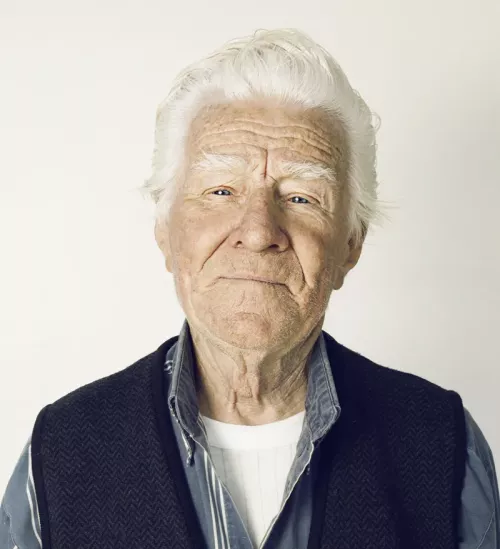
Many of my clients have Parkinson's; some have Alzheimer's or other forms of dementia. Most suffer from depression, loneliness, and a lack of connection in their lives. Working with frail elders nearing the end of life has been one of the most rewarding career paths I could have chosen. However, it isn't for everyone. It certainly has its challenges, but it also has its joys. Let's explore both.
Stocksy.
The Joys
I witness small miracles every day. I see how someone who is depressed, lonely, or agitated can suddenly transform through healing touch, and feel more peace and joy. It is palpable in the expression on their face, their eyes, their mannerisms, the tone of their voice, and the warm smile that suddenly appears. I see how someone who is in bed 24-7 suddenly finds some relief and comfort through a tender caring touch and who expresses it with a glow and sparkle, and the words, "If you only knew how much you helped me—thank you." I see someone who has Alzheimer's suddenly feel a sense of connection and a moment of clarity.
These are moments of grace that I live for each day. They give me great hope and joy. These clients touch me as much as I touch them. I learn from them about what it means to be a better human being—kinder, more compassionate. I learn patience and endurance. I learn about the human condition, the frailties of the aging body and illness, about death and dying—and ultimately about living with passion and purpose.
Are You Meant to Do This Kind of Work?
If working in this kind of specialized practice is something you are thinking about, I suggest you start by asking yourself the following questions:
How do I feel about my own aging and about the aging of my loved ones?
How do I feel about the physical aspects of growing older and becoming more frail and dependent on others?
How do I feel about becoming fond of someone and then losing them? Am I able to separate the two? Am I able to see the greater value in helping to facilitate healing and peace for someone during the final stage in their life over my own feelings of sadness and loss? Or is the emotional loss more overpowering?
Am I able to work with clients in sometimes less-than-pleasant situations, where I may not have the kind of silence I ideally would like to have?
How do I feel about illness, loss, and death?
The Challenges
To be honest, not all days are great, and some are more trying than others. In skilled nursing facilities, there is loss and death. Sometimes clients are not feeling well enough to receive a massage, or they forget they had an appointment with me. I have worked with clients with Alzheimer's who were so agitated that they were not able to sit still for even a moment; every time I got them to sit in a chair, they popped up again to wander around anywhere and everywhere away from me. I have worked with bed-bound clients whose roommates yelled incessantly, or who had their television turned up to the highest volume, or whose family members were visiting and talking loudly. There are many factors that sometimes are out of our hands to control or change and that may interfere with the kind of healing space you are trying to create.
The Grace of the Work
Sadness will always come with loss, but what is more important to me is knowing I may have helped lighten and brighten someone's life, or that I brought more peace, comfort, care, love, and healing to those last days, months, or years of someone's life. Knowing this is infinitely greater than the sadness that will come later. Sadness, like all things in this life, will pass. What stays is the imprint etched in your heart. It is not always easy, and not everyone is able to do it, but the rewards can be immense.
Whatever challenges there may be, I feel truly blessed to touch and be touched by the elders I have worked with, whose bodies may be frail but whose hearts, spirits, and minds have strengthened and nourished me in a profound way. This career has been life-changing. If this is something you might want to investigate, I encourage you to go out there and explore.
Stick Your Toe in the Water
If you think working with frail elders is something you might be interested in, I suggest you try volunteering at a skilled nursing or assisted-living facility.
Assisted living and skilled nursing are vastly different. In skilled nursing, the residents need much more care; most, but not all, are in wheelchairs or may be bed-bound and require 24-7 care.
In assisted living, the residents are typically higher functioning, and most are more ambulatory. Moreover, the setup is more like living in your own small apartment. I work in both settings and like both because it creates a nice balance.
If you find you enjoy working with frail elders, I suggest you prepare yourself by:
Taking a class in geriatric massage.
Learning about different medications used by this population and how they may interact with massage.
Learning about this population's primary medical conditions and how those conditions may inform the way you work with these clients.
Reading as much as you can about the physical, psychological, and physiological impacts of aging.
Educating yourself on the cautions and contraindications of working with this group of clients. For example, aging skin is much thinner than younger skin, and bruises and tears easily; bones are more brittle, and subject to fracture if someone has osteoporosis. These are some important factors to keep in mind before working with someone who is a frail, older adult.
Learning about the different types of dementia, how they manifest differently, and how to effectively communicate with someone who has dementia. A good place to start is by going to www.alz.org and www.idba.org.
To understand tissue-tension barriers, MTs must be constantly present and mindful. Too light and we will not become efficient at creating the healing change that is needed.