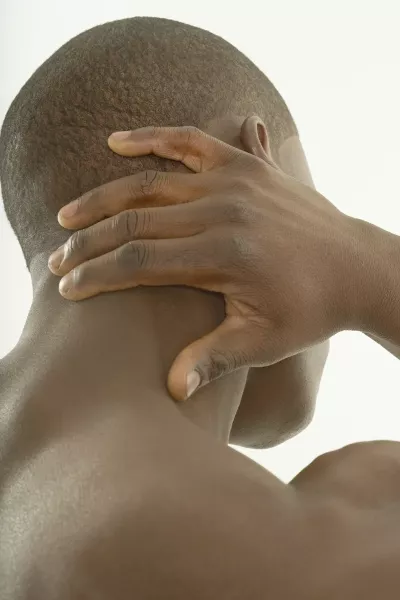
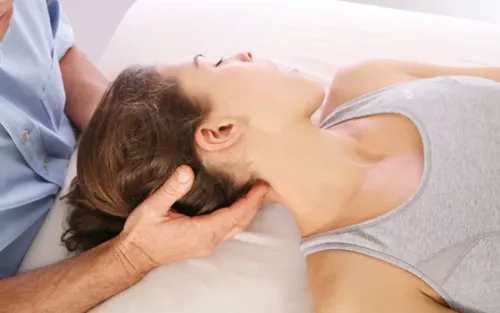
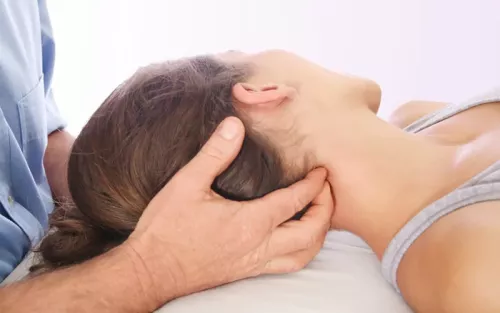
If you place your hand on the back of your neck and open your jaw wide, what do you feel? Does your neck extend slightly? Do your neck muscles contract a bit when your jaw drops (Image 1)?
Image 1. Does the back of your neck contract or extend when you open your jaw? Thinkstock Photos.
If so, you're likely feeling what Moshé Feldenkrais called "parasitic contraction"— habitual muscle activity and tension not necessary for the movement being performed.1 Of course, I wouldn't suggest using the term "parasitic" when talking to your clients about their movement (it's a creepy word, and as therapists, it's good to remember that our language has the power to shape our clients' body sense, in both helpful and unhelpful ways). The point is, in normal circumstances you don't need to tighten or extend your neck in order to open the jaw. Using these extra muscles actually takes more effort, and just adds tension to an area that usually has plenty of that already.
There are many examples of these unnecessary and inefficiently paired movements in the body—the shoulder might lift when the arm reaches; the eyebrows arch when singing loudly; the jaw clenches when opening a jar. There may be a reason for these pairings, in certain situations—extending your neck when opening the jaw can help you open a bit wider, for example; but to the extent that these patterns become unconscious, automatic, and habitual, they can cost us in lost movement efficiency and ease.
For More Learning
"Neck, Jaw & Head," "TMJ & Jaw Issues," or "Whiplash" in the Advanced Myofascial Techniques series of workshops and video courses.
Paired movements of the jaw and cervicals are very common—in one small but often-cited study, all participants' necks extended with jaw opening (and to a lesser extent, flexed with jaw closing).2 That study's authors speculated that this coupling was related to the jaw and neck's shared innervation via the trigeminocervical nucleus in the upper cervical spine. But we should be clear that shared innervation doesn't have to mean "automatically and always linked"; we differentiate the movements of structures with shared innervation whenever we refine our movement skill. For example, the thumb, and the first, and second fingers are all innervated by the median nerve, but can easily learn to operate independently in complex and refined ways, such as in typing, playing a musical instrument, or performing a manual therapy technique.
Likewise, we can also learn to move our jaw independently of our neck; the posterior cervical muscles do not need to contract in order to open the jaw. Try it yourself: return your hand to the back of your neck, and practice letting your jaw gently fall open while your neck stays relaxed and long. Allow your tongue to soften (because interestingly, cervical motion can be inhibited by tongue position3). Make sure your shoulders are relaxed, and your breathing is easy. Most people find it is much easier to open the jaw when these other structures are relaxed.
The Jaw/Cervical Technique
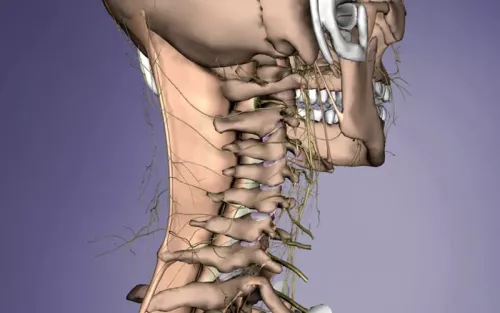
Image 2. The ligaments and facet joint capsules (violet) of the posterior neck can also be gently palpated during active jaw depression, helping clients feel any movement at the deepest and most subtle levels. Image courtesy Primal Pictures.
Along with other awareness-building techniques for the jaw and neck (see "Gentle Techniques for the Jaw and TMJ," Massage & Bodywork, January/February 2017) in our Advanced Myofascial Techniques trainings at Advanced-Trainings.com, we use the Jaw/Cervical Technique as a way for clients with neck or jaw issues to practice new movement options. This technique uses gentle pressure to increase awareness of the muscles and deepest structures of the posterior neck (see Image 2 above).
And, since neck tension, jaw tension, and the above-mentioned trigeminocervical nucleus are each implicated in cervicogenic (neck-related) headaches, migraine headaches, and temporomandibular joint disorders,4 this technique can be a useful and relevant self-care tool for clients dealing with any of these common complaints, or for each of us whose necks or jaws are sometimes more tense than needed. Why not take another second right now to let your own jaw gently fall open once more, as the back of your neck remains long, easy, and relaxed.
The Jaw/Cervical Technique
Indications
Cervical extension or muscular contraction with jaw opening, especially when accompanied by:
Neck tension, pain, or movement restriction
Jaw tension or pain; temporomandibular joint dysfunction (TMD)
Headaches (both tension and migraine)
Purpose
Refine proprioceptive awareness of any jaw/neck movement coupling
Increase self-care options for practicing relaxed and easy jaw movement
Instructions
Image 3. In the Jaw/Cervical Technique, gentle, specific touch is used to help refine the client's proprioception. When your client opens their jaw, feel for contraction or extension in the posterior neck. Use verbal and tactile cues to help the client discover a way to let the jaw open without cervical extension or contraction. Image courtesy Advanced-Trainings.com.
Use your fingertips to gently feel for any posterior neck involvement in slow, active jaw opening (Images 3 and 4).
Check movement with the client's head and neck in a neutral position, as well as in fully rotated positions.
If you find neck extension or contraction with jaw depression, help your client feel this, too, by directing their attention to these sensations with your words and your touch. Use gentle, but specific pressure into any areas of contraction or extension in order to further increase your client's proprioception.
Offer proprioceptive cues such as: "Just allow your jaw to fall open as your neck stays relaxed," "Let your shoulders, tongue, and neck soften as you move," "Let it move even less. Can your jaw move a little before your neck tightens?," etc. Repeat in a seated or standing position; offer as client self-care homework and practice.
Image 4. Image courtesy Advanced-Trainings.com.
Considerations
Keep jaw-opening within the client's comfort range.
Use your touch to help the client feel their unneeded movement or tension, rather than trying to rub or manipulate any tight muscles you find. Keep in mind that this is a reeducation technique, rather than tissue manipulation.
Slow, focused, small, active movements will often be more effective than large, fast movements.
Not everyone has coupled jaw/neck motion. Repeat the test in various positions, but if no coupling is found, this technique is not indicated.
Many jaw problems resolve on their own after a few months of stress reduction and self-care.5 Chronic or severe temporomandibular joint disorder (TMD) sufferers can benefit from a combination of methods, which together offer physical, educational, psychological, and social support.
2. P. O. Eriksson, H. Zafar, E. Nordh, "Concomitant Mandibular and Head-Neck Movements During Jaw Opening-Closing in Man," Journal of Oral Rehabilitation 25, no. 11 (November 1998): 859-70.
3. J. Chew (Producer), "Cervicogenic Headache with Toby Hall," audio podcast, October 2, 2016, http://chewshealth.co.uk/tpmpsession34/; M. J. Ellis, J. J. Leddy, and B. Willer, "Physiological, Vestibulo-Ocular and Cervicogenic Post-Concussion Disorders: An Evidence-Based Classification System with Directions for Treatment," Brain Injury 29, no. 2 (2015): 238-48; D. M. Biondi, "Cervicogenic Headache: A Review of Diagnostic and Treatment Strategies," The Journal of the American Osteopathic Association 105 (April 2005): 16S-22S.
4. Prin Chitsantikul and Werner J. Becker, "Treatment of Cervicogenic Headache: New Insights on the Treatment of Pain in the Neck," Canadian Journal of Neurological Sciences 42, no. 6 (2015): 357-359; Simon Akerman, Bruce Simon, Marcela Romero-Reyes, "Vagus Nerve Stimulation Suppresses Acute Noxious Activation of Trigeminocervical Neurons in Animal Models of Primary Headache," Neurobiology of Disease 102 (2017): 96-104; José G. Speciali and Fabíolam Dach, "Temporomandibular Dysfunction and Headache Disorder," Headache: The Journal of Head and Face Pain 55, no. 1 (2015): 72-83.
5. TMJ Association, "TMJ Science Overview," January 7, 2016, accessed March 2017, www.tmj.org/Page/51/32.
To understand tissue-tension barriers, MTs must be constantly present and mindful. Too light and we will not become efficient at creating the healing change that is needed.