Body parts can get stuck together. This can have structural causes, such as when scarring causes layers of connective tissue to adhere to each other, or be a functional issue, such as when it's hard for the brain to move just one part without also moving other unrelated parts at the same time. Structural and functional coupling both have useful roles—to some extent, the more things that participate in a given movement, the more support, stability, and power we have. But when body parts are over-coupled and work more than they need to, we not only waste energy, but also sacrifice coordination, grace, and refinement.
As massage and manual therapists, our collective legacy includes methodologies that address both structural and functional over-coupling. Dr. Ida Rolf's structural integration, true to its name, originally emphasized the "structural" or tissue-based aspects of over-coupling. She speculated that the deep pressure classically associated with her method changed the physical properties of the body's connective tissues, freeing them up where inelastic or stuck.1 "Differentiation" was the traditional goal of the middle phase of her 10-session series; she said this freeing-up was necessary before a new, more integrated order could emerge.2
Moshe Feldenkrais, on the other hand, emphasized awareness and sensory-based distinctions over tissue-based differentiation. He called his hands-on method "Functional Integration," reportedly as a friendly riposte to Rolf's emphasis on structure (in medicine, one definition of "functional" is "nonstructural"). Rather than using direct pressure to liberate over-coupled parts, Feldenkrais's method uses tactile and verbal cues to help highlight the client's felt experience of over-coupling. Often, his method involved comparing two or more movements, so that the freer, less stuck-together, and less-efforted option became clear.3
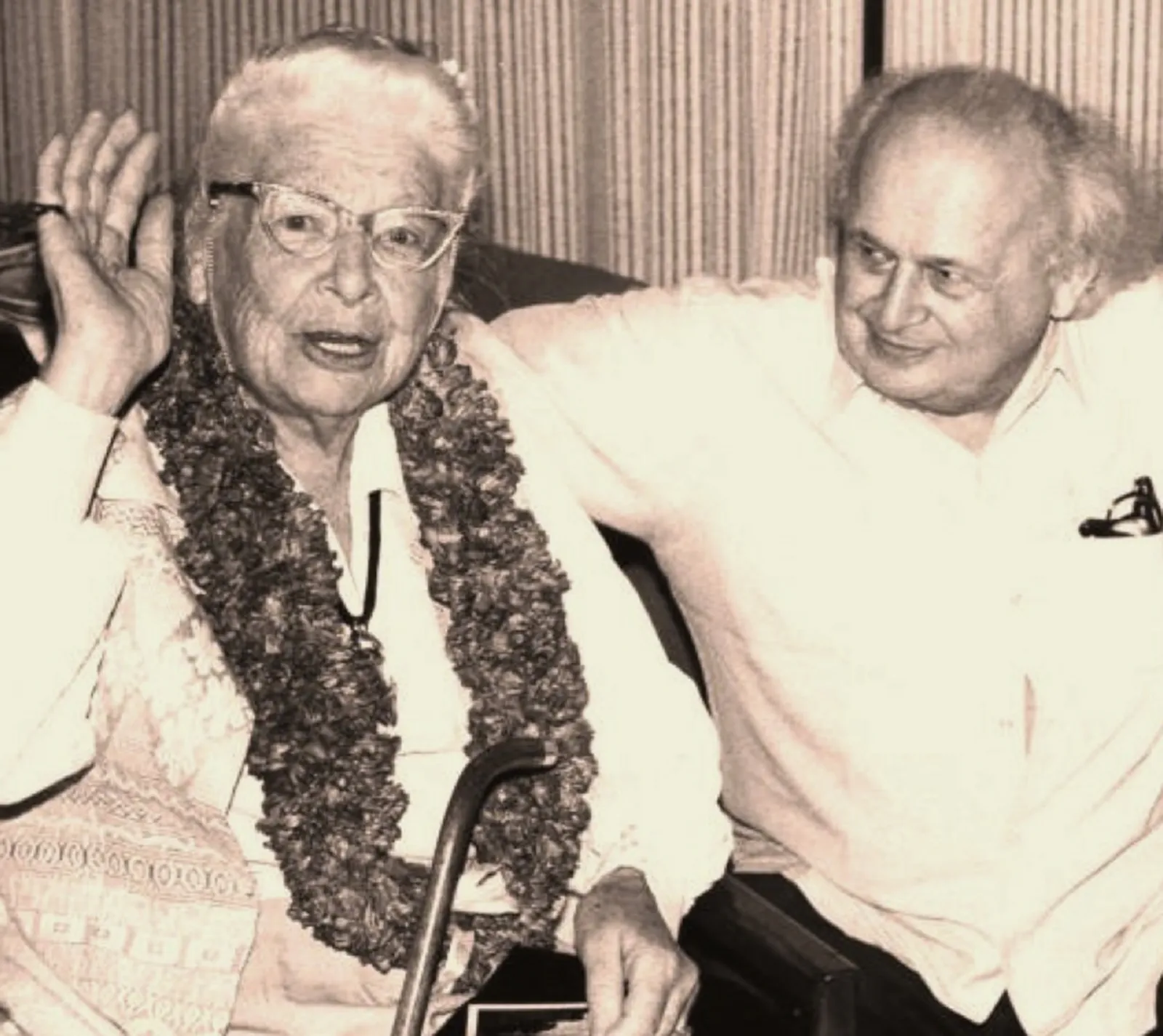
Ida Rolf and Moshe Feldenkrais, seen here in 1974, pioneered contrasting but complementary body therapy approaches. Though Rolf explained her method in terms of physical tissue-level changes, she also cited Feldenkrais (who emphasized learning and awareness over structural change) as one of her primary influences. Image courtesy W. Silva.
Though Rolf was famously private about her sources, she did name Feldenkrais as a notable influence on her work.4 Friends in their later years (Image 1), their approaches weren't as opposed as they might appear. In a letter to Rolf on her 78th birthday, Feldenkrais wrote:
Structural integration and functional integration have more in common than the word that connects them. Indeed, and in the case of humans, structure and function are meaningless, one without the other; so that when you integrate structure as nobody else can, you improve functioning.5
In honor of these two pioneers' complementary approaches, I'll describe a technique—Ankle/Quadriceps Decoupling—that I learned in my early structural integration training, though you can see that it is primarily a functional reeducation technique. Even though the quadriceps are not necessary for ankle dorsiflexion, most people automatically contract their thigh when bringing the foot up with a straight leg. As with the Jaw/Cervical Technique ("Uncoupling the Neck and Jaw," Massage & Bodywork, May/June 2017), you can adapt it to other parts of the body, and use its principles to minimize what Feldenkrais called "parasitic tensions": the unnecessary participation of other structures in any desired movement.6 Your clients will feel lighter and freer, and move easier as a result.
Ankle/Quadriceps Decoupling Technique
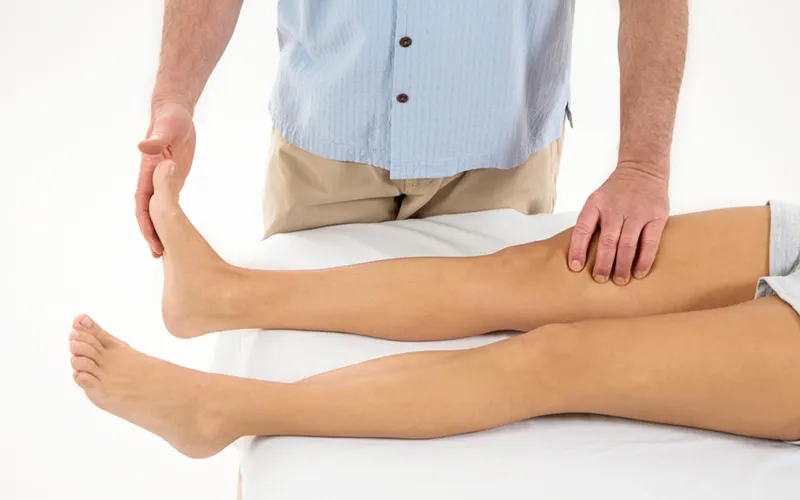
The Ankle/Quadriceps Decoupling Technique helps clients learn easier ways to move by reducing "parasitic tension" in the quadriceps during ankle movement. Image 2 courtesy Advanced-Trainings.com.
Purpose
Refine proprioceptive awareness of any unneeded quadriceps contraction during ankle dorsiflexion.
Increase options for relaxed, differentiated, and easy ankle movement.
These overlapping goals can help enhance clients' balance, coordination, and stability, as well as movement ease and efficiency.
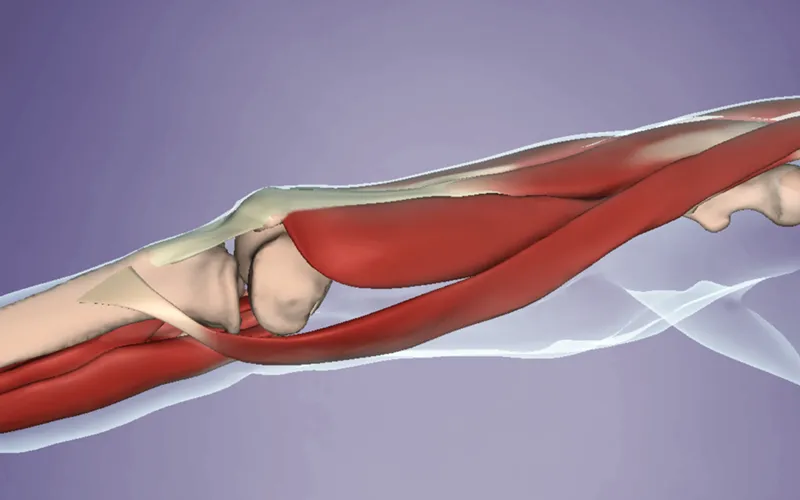
Although the quadriceps don't pull up on the foot in ankle dorsiflexion, they do help brace the knee; learning to relax unnecessary bracing is one of the key ways that massage and bodywork effects last. Image 3 courtesy Primal Pictures.
Learn More
Feldenkrais Method: Moshe Feldenkrais, Awareness Through Movement (HarperOne, 1990).
With your client's leg straight, ask for active ankle dorsiflexion: "Flex and extend your ankle fully," or, "Bring your foot all the way up, and all the way down."
Use gentle pressure to feel for any quadriceps contraction during active ankle movement, particularly during dorsiflexion (see Images 2 and 3). If contraction is not obvious, ask for slower or fuller ankle movement, or check other parts of the quadriceps group.
Help your client feel any contraction by directing their attention to these sensations with your words and touch. Use gentle but specific pressure into any areas of contraction in order to further refine your client's proprioception.
Offer proprioceptive questions and feedback cues such as: "Can your foot come up while your leg stays relaxed right here?" "How about with a smaller movement? Or slower?" "That's it—I don't feel your thigh contracting now. What's that like for you?" etc.
Repeat in a seated position; offer as client self-care homework and practice.
Considerations
Keep your pressure within the client's comfort range.
Use your touch to help the client feel their unneeded contractions, rather than trying to rub or manipulate any tight muscles you find. Keep in mind that this is a reeducation technique, rather than tissue manipulation per se.
Slow, focused, small, active movements will often be more effective than large, fast movements.
Notes
1. Though there is growing agreement that hands-on work produces less actual tissue change than was thought in Ida Rolf's time, there is no consensus yet about whether tissue change plays some role or no role in bodywork's benefits, with reasonable evidence on both sides of the debate.
2. Ida P. Rolf, The Integration of Human Structures (New York: Harper & Row, 1997): 94.
3. S. Hillier and A. Worley, "The Effectiveness of the Feldenkrais Method: A Systematic Review of the Evidence," Evidence-Based Complementary and Alternative Medicine, no. 1 (May 2015): 1-12, https://doi.org/10.1155/2015/752160.
To understand tissue-tension barriers, MTs must be constantly present and mindful. Too light and we will not become efficient at creating the healing change that is needed.